How Freelancers and Consultants Can Turn Their Online Presence Into More Clients
Learn how freelancers and consultants can build credibility, showcase their work, strengthen their personal brand and turn online visitors into clients.
Getting noticed online isn't the hardest part anymore.
Turning that attention into an actual business opportunity is.
A freelancer might have thousands of LinkedIn connections but struggle to generate consistent inquiries. A consultant may regularly publish useful content but still depend almost entirely on referrals. A designer might have an impressive portfolio yet receive very few serious project requests.
The problem often isn't talent.
It isn't necessarily traffic either.
The problem is what happens after someone becomes interested in you.
Where do they go?
What do they see?
Can they quickly understand what you do?
Can they see proof of your work?
And most importantly, can they easily contact you?
For independent professionals, these questions are becoming increasingly important because the journey from discovering someone to hiring them now happens largely online.
That's why freelancers, consultants, creators, developers, designers, marketers, and other independent professionals should start treating their online presence as more than a digital resume.
It should function as a client acquisition system.
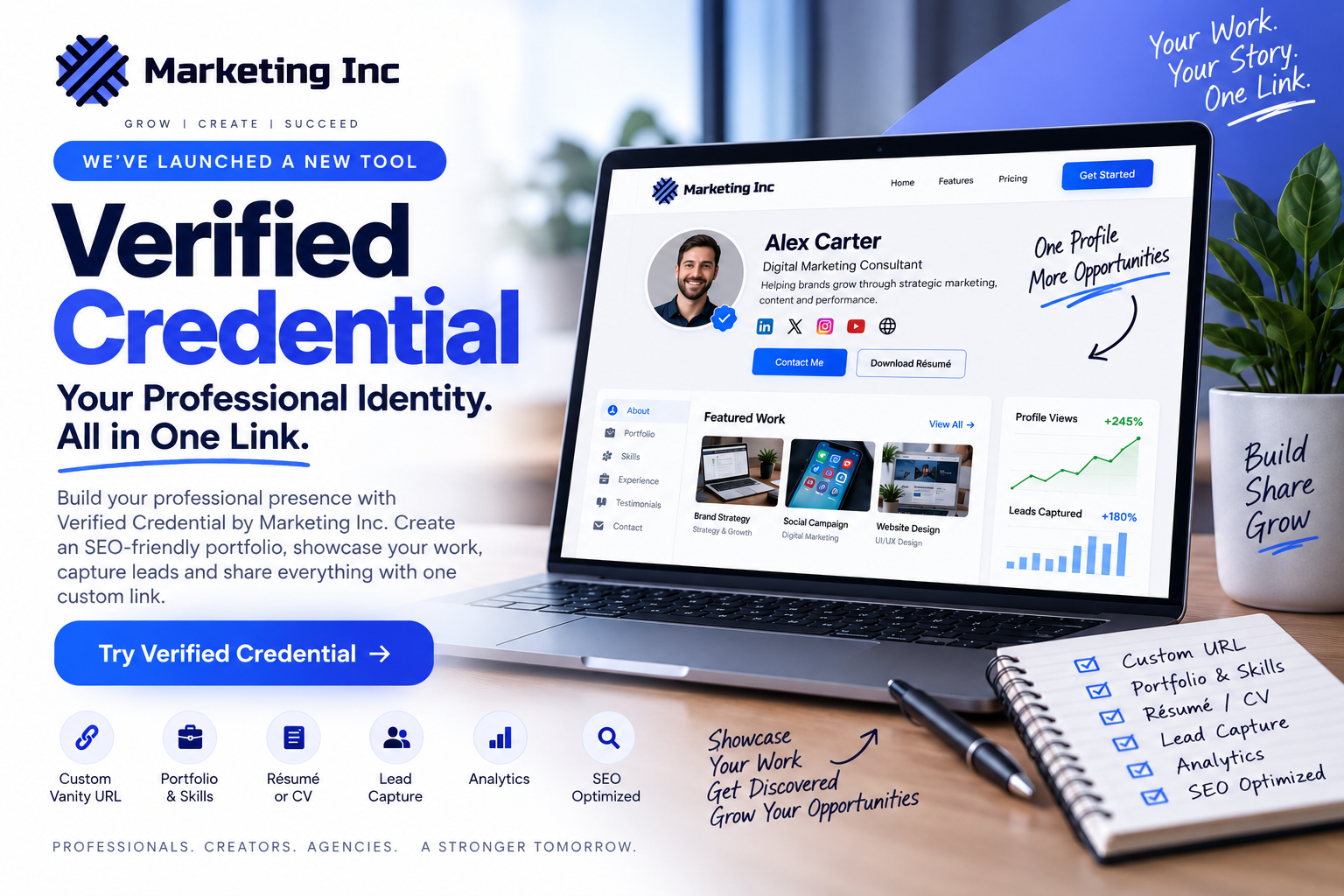
Tools such as Verified Credential by Marketing Inc are being built around this idea by combining a professional profile, portfolio, skills, resume, contact information, lead capture, analytics, and a custom professional URL in one place.
But before discussing tools, it's important to understand why the traditional approach to building an online professional presence often fails.
Having an Online Presence Doesn't Mean You Have a Client Acquisition System
Most freelancers already have an online presence.
They might have LinkedIn.
Instagram.
A portfolio website.
A profile on a freelance marketplace.
Perhaps they occasionally post on X, Threads, or another social platform.
But simply existing online doesn't automatically generate business.
There is a significant difference between visibility and conversion.
Visibility means someone knows you exist.
Conversion means they take the next step.
Imagine a consultant writes a great LinkedIn post.
Five thousand people see it.
Two hundred people visit the consultant's profile.
Twenty are potential clients.
But when they reach the profile, there isn't a clear portfolio, case study, service explanation, or obvious way to make an inquiry.
Most visitors leave.
The consultant technically generated attention.
But very little business came from it.
That's why your professional online presence needs to answer a simple question:
What should an interested person do next?
If the answer isn't obvious, you're probably losing opportunities.
The Modern Client Journey Starts Before Someone Contacts You
Years ago, a referral might lead directly to a phone call.
Today, a referral often leads to Google.
Suppose a business owner tells another business owner:
"You should talk to Sarah. She's an excellent marketing consultant."
The prospect may not immediately call Sarah.
Instead, they search:
"Sarah Johnson marketing consultant."
They check LinkedIn.
They look for a website.
They review previous work.
They might look at social media.
They may even search for interviews, articles, or reviews.
Only after completing this informal research process do they decide whether to contact Sarah.
That means your digital presence is participating in the sales process before you ever know the prospect exists.
Your profile, portfolio, search results, website, and content are effectively conducting the first sales meeting for you.
And they need to make a good impression.
Step One: Make It Immediately Clear What You Do
One of the biggest mistakes freelancers make is trying to sound impressive instead of being clear.
Consider a headline like:
"Helping brands unlock transformational growth through innovative digital experiences."
It sounds polished.
But what exactly does the person do?
Compare it with:
"I build conversion-focused websites for B2B SaaS companies."
Now the visitor understands immediately.
Clarity beats cleverness when someone is evaluating whether you can solve their problem.
Your professional profile should quickly communicate three things:
What you do.
Who you do it for.
What outcome you help create.
For example:
"I help Florida law firms generate qualified leads through SEO and paid search."
Or:
"I build AI automation systems for small businesses that want to reduce repetitive administrative work."
Or:
"I design mobile apps for early-stage startups preparing to launch their MVP."
These statements give potential clients context immediately.
They can decide whether your expertise matches their needs.
Step Two: Show Your Work
Once someone understands what you do, their next question is predictable:
Can you actually do it?
This is where your portfolio becomes critical.
For years, portfolios were primarily associated with designers, photographers, and creative professionals.
That has changed.
Almost every knowledge-based professional can benefit from showing evidence of their work.
A developer can showcase applications.
A marketing consultant can showcase campaigns.
A copywriter can showcase articles and landing pages.
An SEO consultant can demonstrate organic growth.
An AI specialist can showcase tools and automations.
A fractional executive can highlight business outcomes.
A sales consultant can discuss revenue improvements.
Your portfolio doesn't need hundreds of projects.
In many cases, three to six strong examples are more effective than dozens of mediocre ones.
For each project, explain the situation, what you contributed, and the outcome.
Potential clients don't simply want to see what something looked like.
They want to understand the value you created.
Step Three: Stop Sending Prospects Five Different Links
This is a surprisingly common problem.
Someone asks:
"Can you send me some examples of your work?"
You respond with your website.
Then another link to your LinkedIn profile.
Then a Google Drive link to your resume.
Then another link to a case study.
Then perhaps your Calendly link.
Now your prospect has homework.
That's not ideal.
Every additional step creates an opportunity for someone to get distracted.
A better strategy is creating one central professional destination.
This is one of the reasons platforms such as Verified Credential can be useful for independent professionals.
The idea is to combine your professional profile, skills, portfolio, resume, social links, contact information, and lead capture into a single page.
You can then use one professional URL across multiple channels.
Think of it as the hub of your professional identity.
Social media generates discovery.
Content creates authority.
Networking creates relationships.
Referrals create trust.
Your professional profile gives all of that attention somewhere to go.
Step Four: Turn Your Portfolio Into a Lead Generation Tool
A portfolio shouldn't end with someone thinking:
"Nice work."
It should encourage them to take action.
This doesn't mean covering your page with aggressive "BUY NOW" buttons.
It means making the next step obvious.
For example:
"Interested in working together?"
"Have a project you'd like to discuss?"
"Looking for help with your next product?"
The visitor should immediately understand how to contact you.
Verified Credential includes visitor lead capture directly within the professional profile, which is particularly relevant for freelancers and consultants.
Instead of functioning only as a static portfolio, the profile can become part of your lead-generation funnel.
That distinction is important.
A portfolio displays your work.
A client acquisition profile displays your work and creates an opportunity to start a conversation.
Independent professionals need both.
Step Five: Build Credibility Before Asking for the Sale
People hire people they trust.
And online trust is built through signals.
Your professional experience is one signal.
Your portfolio is another.
Your skills are another.
Your content contributes.
Your resume contributes.
Professional recognition contributes.
Client results contribute.
Even the quality and consistency of your digital presence contribute.
No individual signal usually closes a client.
Together, however, they create confidence.
This is why scattered professional information can become a disadvantage.
If a potential client has to search across several websites to determine whether you're credible, you are making their decision unnecessarily difficult.
Bring your strongest credibility signals together.
The goal isn't to tell visitors you're trustworthy.
The goal is to give them enough evidence to reach that conclusion themselves.
Step Six: Build a Personal Brand Around Expertise, Not Popularity
One misconception about personal branding is that success requires a massive audience.
It doesn't.
Consider two consultants.
Consultant A has 50,000 social media followers but a broad audience.
Consultant B has 2,000 followers consisting primarily of executives within a specific industry.
Who has the stronger business opportunity?
Potentially Consultant B.
For freelancers and consultants, relevance matters more than raw audience size.
You don't need everyone to know who you are.
You need the right people to understand why you're valuable.
That changes how you approach content.
Instead of asking:
"How can I get more followers?"
Ask:
"What would make my ideal client trust my expertise?"
Publish insights around problems your customers experience.
Explain your process.
Share lessons from projects.
Discuss mistakes businesses commonly make.
Show examples.
Create useful resources.
Then direct interested readers toward your professional profile.
Content becomes the discovery engine.
Your profile becomes the conversion layer.
Step Seven: Think About Personal SEO
Social media isn't the only place clients discover professionals.
Search remains extremely important.
And one of the most valuable searches can be your own name.
Imagine someone receives a recommendation:
"Talk to Daniel Patel. He's excellent at AI automation."
The prospect searches:
"Daniel Patel AI automation."
What appears?
This is where personal SEO becomes relevant.
You want search engines to associate your name with your expertise.
Creating an optimized professional profile can contribute to that presence.
Verified Credential includes an SEO-optimized professional profile, giving professionals another structured destination that can potentially appear around relevant searches.
Of course, no platform can guarantee Google rankings.
SEO depends on many factors.
But professionals can improve their digital footprint by creating consistent information around their name, profession, expertise, portfolio, and online presence.
You can strengthen that further through guest posts, podcast appearances, professional directories, social profiles, and backlinks from reputable websites.
Over time, these signals help establish your digital identity.
Step Eight: Use Your Professional Link Everywhere
Creating a strong professional page doesn't help much if nobody sees it.
Distribution matters.
Once you've established a central professional URL, integrate it into your everyday activities.
Put it in your email signature.
Add it to LinkedIn.
Include it in proposals.
Add it to your resume.
Place it in your social bios.
Use it on business cards.
Add a QR code pointing to it at conferences.
Include it in podcast guest bios.
Send it after networking conversations.
Use it in cold outreach.
Include it in contributor profiles when publishing articles.
The objective is consistency.
Instead of sending different people to different destinations, you begin building recognition around one professional URL.
Over time, that page becomes increasingly associated with your professional identity.
Step Nine: Measure What's Happening
Marketing without measurement becomes guesswork.
Yet that's how most people manage their personal brand.
They post.
They network.
They send emails.
They attend events.
They publish articles.
But they have very little visibility into whether those activities are creating interest.
That's another reason analytics matter.
Verified Credential provides analytics for profile views and leads, allowing users to see engagement around their professional profile.
Imagine publishing a guest article on an industry website.
Your author bio links to your professional page.
You notice an increase in profile views afterward.
That tells you something.
Perhaps you speak at an event.
You include your professional link on the final slide.
Profile traffic increases.
That's another signal.
Maybe you add the link to your email signature and notice consistent engagement.
Now you know people are actually using it.
Once personal branding becomes measurable, you can make better decisions about where to spend your time.
How Much Does Verified Credential Cost?
For freelancers and consultants who want to create this type of centralized professional presence, Marketing Inc currently offers Verified Credential for $1 for the first month, followed by $199 per year.
The individual plan includes a verified professional profile page, custom vanity URL, portfolio and skills showcase, resume or CV upload and download, visitor lead capture, profile and lead analytics, social links, contact information, and SEO optimization.
The subscription automatically renews and can be canceled anytime.
The $1 introductory month makes it possible to build your professional page and explore the platform before moving into the annual subscription.
For professionals who might otherwise purchase website hosting, portfolio software, analytics, contact-form tools, and other services separately, the appeal is having the core elements of a professional presence centralized.
There's Also an Option for Agencies
Freelancers aren't the only ones dealing with fragmented credibility.
Agencies face the same challenge.
Potential clients want to see services, team members, previous projects, case studies, awards, and other credibility indicators before starting a conversation.
Marketing Inc offers Agency Hub for this use case.
Agency Hub currently starts at $1 for the first month and then costs $499 per year.
It includes a verified agency profile, custom agency URL, team and services showcase, case studies and portfolio functionality, client lead capture and CRM, analytics, award and recognition displays, and SEO optimization.
The philosophy is similar to the individual product.
Bring the information potential clients need into one professional destination.
The Best Freelancer Websites Reduce Friction
When evaluating your own online presence, ask yourself a few questions.
If someone discovers me today, can they immediately understand what I do?
Can they see evidence of my work?
Can they understand my experience?
Can they find my resume if they need it?
Can they easily contact me?
Can they find my social profiles?
Can they share my professional information with another decision-maker?
If the answer to several of those questions is no, you may not have a traffic problem.
You may have a conversion problem.
This is particularly important for freelancers because acquiring new clients is expensive in terms of time.
You might spend hours networking.
Hours creating content.
Hours sending proposals.
Hours doing outreach.
Hours participating in communities.
If all of those activities generate attention but your professional presence doesn't convert that attention into conversations, you're losing some of the value of the work you've already done.
Your Online Presence Should Work When You're Not Working
This may be the most important reason to build a strong professional profile.
You cannot be online constantly.
You cannot personally explain your background to every potential client.
You cannot attend every networking event.
You cannot respond instantly to every referral.
But your professional profile can remain available.
At 2:00 PM, someone can view your work.
At 11:00 PM, someone can read about your expertise.
On Saturday morning, a referral can search your name.
While you're on vacation, a potential customer can discover your portfolio.
Your digital presence becomes a salesperson that doesn't need to sleep.
It explains.
It demonstrates.
It builds confidence.
And when designed correctly, it provides the visitor with a way to take the next step.
Stop Treating Your Professional Profile Like a Resume
The biggest shift freelancers and consultants need to make isn't technological.
It's strategic.
Stop thinking about your online professional presence purely as a place where people can learn about your employment history.
Start thinking about it as infrastructure for your business.
Your professional page should help people:
Discover you.
Understand you.
Evaluate you.
Trust you.
Contact you.
That's why solutions such as Verified Credential from Marketing Inc are worth paying attention to.
They represent a broader evolution from static professional profiles toward more complete professional identity and lead-generation platforms.
The freelancer economy is becoming increasingly competitive.
AI is making it easier for more people to offer professional services.
Remote work has expanded competition globally.
Clients have more choices than ever.
In that environment, simply being skilled isn't enough.
You have to make your value easy to understand.
And you have to make choosing you easy.
Your next client may already be looking at your LinkedIn profile, reading one of your articles, receiving your name from a referral, or searching for your expertise on Google.
The opportunity isn't always getting more people to discover you.
Sometimes it's doing a better job with the people who already have.
Build an online presence that doesn't just get viewed. Build one that creates opportunities.
Share Article
About the Author
Sourabh Mate
View all articles →
Category
WebsitesArticle Highlights
- Expert strategies proven across multiple industries
- Step-by-step implementation guides for immediate results
- Real-world case studies with measurable outcomes
- Latest industry trends and emerging technologies
Websites
Part of A Digital Agency's comprehensive resource library — expert guides, insights, and case studies covering every aspect of modern digital marketing.
More in Websites
June 28, 2026
PodcastInc.ai: The AI Platform Helping Podcasters Scale Faster, Create More, and Earn Smarter
PodcastInc.ai uses AI to automate podcast creation, repurposing, and growth. Scale faster and earn by joining the affiliate program.
June 28, 2026
Has AI Become the Ultimate Influencer?
Traditionally, an influencer was someone with charisma, visibility, and a loyal following. But in the 21st century, influence is less about personality and more about presence. AI systems are omnipres
June 28, 2026
From Concept to Launch: A Case Study on Successful Web Development
Explore a detailed case study on the complete web development process—from ideation to launch. Learn key phases, challenges, tools, and strategies behind building a successful website.