

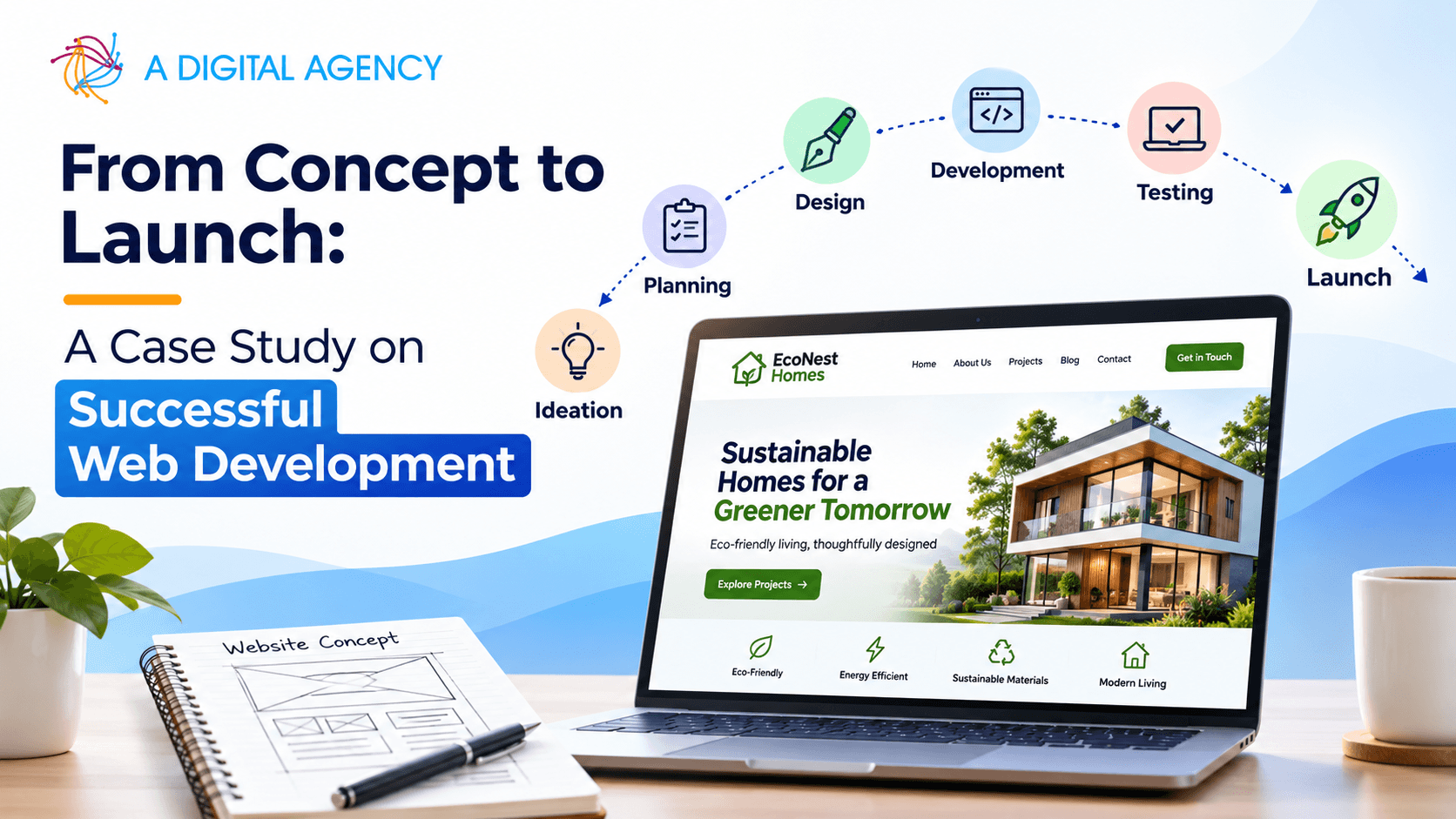
From Concept to Launch: A Case Study on Successful Web Development
Explore a complete web development case study, from planning and UX design to coding, testing, launch, and ongoing optimization for business growth.
Building a successful website involves much more than creating attractive pages and publishing them online. Behind every effective digital experience is a carefully planned process involving business strategy, user experience, technology selection, development, testing, and continuous improvement.
For businesses, a website represents more than an online presence. It can attract customers, communicate brand values, generate leads, and support long-term growth. However, achieving these results requires collaboration between designers, developers, marketers, and business stakeholders.
This web development case study explores the journey of EcoNest Homes, a sustainable housing startup, from its initial website concept to launch and post-launch optimization.
By examining the project's planning decisions, technical architecture, design approach, development process, and reported outcomes, we can identify practical lessons for businesses preparing to build or redesign their websites.
Project Overview: Understanding the Business Challenge
EcoNest Homes was developing a digital platform to promote sustainable housing solutions and connect with environmentally conscious homebuyers.
The company needed a professional website capable of showcasing residential projects while educating visitors about environmentally responsible construction practices.
Its existing business requirements demanded more than a simple informational website. The platform needed to combine visual storytelling, educational resources, and customer inquiry functionality.
Primary Project Objectives
The development team identified several essential objectives:
-
Create a modern, responsive website accessible across devices.
-
Showcase completed and upcoming sustainable housing projects.
-
Develop an intuitive navigation structure for visitors.
-
Implement a content management system for easy updates.
-
Establish a strong technical foundation for search visibility.
-
Include a blog, project portfolio, testimonials, and contact forms.
The central challenge was creating a visually engaging experience without sacrificing performance, accessibility, or future scalability.
Phase 1: Discovery and Requirement Gathering
Every successful web development project begins with understanding the business problem.
The EcoNest Homes team organized discovery sessions involving stakeholders, designers, developers, and marketing specialists.
These conversations established the website's objectives, target audience, functionality requirements, and expected user experience.
Identifying the Target Audience
The primary audience consisted of environmentally conscious prospective homeowners, particularly adults interested in sustainable construction and energy-efficient living.
Understanding this audience influenced decisions about website messaging, imagery, navigation, and content.
Rather than overwhelming visitors with technical terminology, the website needed to explain sustainable housing concepts through accessible information.
Defining Essential Features
The team identified several important requirements, including a searchable project portfolio, educational blog, email subscription functionality, and multilingual capabilities for future expansion.
Each feature was evaluated according to its business importance and development complexity.
This helped establish a realistic project scope while preventing unnecessary functionality from delaying the launch.
Conducting Competitor Research
Competitor analysis provided insights into how other sustainable housing companies presented their services online.
The team reviewed navigation structures, visual layouts, content approaches, and customer conversion opportunities.
These findings helped identify ways EcoNest Homes could differentiate itself through clearer information and a more intuitive user experience.
Phase 2: Planning the Website Architecture
Once the requirements were established, the project moved into technical and structural planning.
A clear website architecture helps users find relevant information while supporting search engine discovery.
Developing the Sitemap
The planned structure included six main sections: Home, About Us, Projects, Blog, Resources, and Contact.
Each page supported a specific business objective.
The homepage introduced the brand, while the Projects section showcased housing developments. Educational resources addressed customer questions, and contact pages encouraged inquiries.
Creating Wireframes
Wireframes provided simplified representations of website layouts before detailed visual design began.
The team planned content hierarchy, navigation placement, image sections, and calls to action.
Mobile usability was considered from the beginning rather than being treated as a final adjustment.
Early wireframe reviews helped stakeholders provide feedback before development resources were committed.
Phase 3: Selecting the Right Technology Stack
Technology selection can influence website performance, maintenance costs, security, and scalability.
For EcoNest Homes, the development team selected a modern technology stack based on its functional requirements.
The frontend used React.js and Tailwind CSS to create reusable interface components and responsive layouts.
Node.js and Express supported backend functionality, while MongoDB handled structured application data.
Strapi served as the headless content management system, allowing authorized users to update website content without changing application code.
The frontend was planned for deployment through Vercel, with backend services hosted on Render.
This approach separated content management, presentation, and application logic.
Although this architecture offered flexibility, it also required careful coordination between frontend and backend services.
Phase 4: Designing an Engaging User Experience
Website design plays an important role in communicating business credibility and helping visitors complete meaningful actions.
The design team developed detailed interface mockups using Figma.
Creating a Consistent Visual Identity
The website's visual direction reflected the company's environmental focus.
Green, white, and earthy brown tones helped establish a recognizable brand identity.
Typography, photography, icons, and spacing were selected to create a balanced presentation.
Prominent calls to action encouraged visitors to explore sustainable housing projects and request information.
Prioritizing Responsive Design
A mobile responsive website ensures that layouts adapt to different screen sizes.
The team designed flexible navigation, responsive typography, and adaptable content sections.
Mobile layouts focused on readability, accessible buttons, and straightforward navigation.
This helped create consistent experiences across smartphones, tablets, and desktop devices.
Addressing Accessibility
Accessibility was incorporated through readable color contrast, keyboard navigation, and compatibility considerations for assistive technologies.
The design process referenced established web accessibility guidelines.
These decisions helped improve usability for a broader range of visitors.
Stakeholder feedback was collected through two design review rounds before implementation.
Phase 5: Frontend and Backend Development
With the visual design approved, developers began converting the mockups into a functional website.
Building Reusable Frontend Components
The frontend team developed reusable elements such as navigation menus, hero sections, project cards, blog layouts, and contact forms.
React components helped maintain consistency across pages and simplified future changes.
Tailwind CSS provided a utility-based styling approach, allowing developers to implement responsive layouts efficiently.
Reusable architecture also supported the project's future expansion plans.
Developing Backend Functionality
The backend team implemented application services for content delivery and user interactions.
REST APIs connected the frontend with the content management system.
Additional functionality supported contact form submissions, blog pages, project information, and administrative access.
Strapi enabled authorized marketing users to publish and edit information independently.
The team also considered authentication, input validation, and secure data handling during development.
Phase 6: Search Engine and Performance Optimization
Search engine optimization was incorporated throughout development rather than postponed until launch.
The team implemented descriptive page titles, metadata, structured navigation, XML sitemaps, and search-friendly URLs.
Dynamic pages required particular attention to ensure important content could be discovered and understood by search engines.
Image optimization, code splitting, and lazy loading helped reduce unnecessary page weight.
Improving Website Performance
Fast-loading pages support user satisfaction and reduce friction during navigation.
The developers reviewed loading behavior, image delivery, and frontend resource usage.
Google's Core Web Vitals framework provides useful measurements for evaluating loading performance, responsiveness, and visual stability.
Performance testing also helped the team identify technical issues before public release.
According to the supplied case study, performance optimization was an important factor in the website's reported results.
Phase 7: Quality Assurance and Website Testing
Testing helps prevent functional defects, accessibility barriers, and inconsistent experiences across devices.
The EcoNest Homes project included both manual and automated quality assurance.
Cross-Browser and Device Testing
The team reviewed website functionality across Chrome, Firefox, Safari, and Edge.
Testing also covered desktop computers, tablets, and smartphones.
Navigation menus, contact forms, project galleries, and responsive layouts were checked for expected behavior.
Automated Testing
Jest supported unit testing, while additional integration tests evaluated interactions between application components.
Accessibility testing used axe-core, and k6 supported load testing.
Issues were recorded in Jira and categorized according to severity.
After developers implemented corrections, regression testing helped confirm that existing functionality remained stable.
This structured approach reduced the risk of launching with unresolved critical defects.
Phase 8: Content Preparation and Website Launch
Before launch, the content team populated the website with company information, project descriptions, educational articles, and customer testimonials.
Content followed established branding guidelines to maintain consistent messaging.
Final Launch Preparation
The pre-launch checklist included SSL configuration, administrative access verification, browser testing, analytics setup, SEO checks, and backup planning.
Google Analytics 4 and Hotjar were configured to support post-launch measurement.
The team also reviewed contact forms, internal navigation, and potential broken links.
Launch Execution
According to the project documentation, the website launched on December 1, 2024, following internal review.
The development team monitored server behavior, application logs, website traffic, and form submissions.
This monitoring helped identify potential issues before they could significantly affect visitors.
Results and Business Impact
The supplied case study reports several positive outcomes following the launch.
| Performance Metric | Reported Result |
|---|---|
| First-month website visitors | 8,400 |
| Average load time | 1.8 seconds |
| Newsletter signup conversion rate | 6.2% |
| Bounce rate | 29% |
| Mobile PageSpeed Insights score | 97 |
| Desktop PageSpeed Insights score | 100 |
These figures illustrate the performance reported in the project documentation, although the underlying analytics reports were not provided for independent validation.
Visitor feedback reportedly highlighted intuitive navigation, attractive visuals, and helpful educational content.
The client also reported increased project inquiries, suggesting that the website supported broader business development objectives.
Post-Launch Optimization and Continuous Improvement
A successful website launch marks the beginning of ongoing performance improvement.
The team monitored website activity using Google Analytics 4 and Hotjar.
Heatmaps and session recordings helped identify how visitors interacted with content.
Conversion analysis highlighted opportunities to simplify forms and improve important calls to action.
A/B Testing and Conversion Improvements
The team compared different button messages, page layouts, and content placements.
Testing included variations of consultation calls to action and blog presentation.
According to the supplied case study, these improvements contributed to a conversion rate increase exceeding 20% during the first two months after launch.
The precise measurement methodology was not included, so the figure should be interpreted as a reported project outcome.
Maintaining Security and Reliability
Ongoing maintenance included software updates, performance monitoring, CMS upgrades, and bug resolution.
Regular maintenance helped protect website reliability while supporting future feature development.
Planning for Long-Term Scalability
The original architecture was designed to accommodate additional business requirements.
Reusable components and headless content management created opportunities to expand beyond the initial website.
Future plans included a client dashboard, sustainability calculator, and referral system.
Multilingual capabilities were also considered to support potential expansion into additional markets.
This forward-looking approach helped reduce the need for fundamental architectural changes when adding new features.
Key Lessons From the Web Development Case Study
Several practical lessons emerge from this project.
Begin with clear business objectives. Discovery sessions establish priorities and reduce confusion during development.
Validate designs early. Wireframes and stakeholder reviews help identify usability problems before implementation.
Choose technology according to requirements. A sophisticated technology stack is valuable only when it supports genuine business needs.
Prioritize performance and accessibility. These qualities should influence development decisions from the beginning.
Test before launching. Structured quality assurance reduces avoidable technical and user experience problems.
Measure results continuously. Analytics and customer feedback provide direction for meaningful improvements.
Successful web development depends on coordinated decision-making across every phase, not simply the technical ability to write code.
Conclusion
Taking a website from concept to launch requires careful planning, thoughtful design, reliable development, comprehensive testing, and ongoing optimization.
The EcoNest Homes case study demonstrates how these activities can work together to support business objectives and create a stronger digital experience.
From defining audience needs to selecting technologies and measuring website performance, every stage contributes to the overall quality of the finished platform.
For businesses preparing a new website, the most important lesson is to focus on long-term value rather than launch day alone.
A successful website should remain accessible, adaptable, secure, and useful as customer expectations and business requirements evolve.
By combining strategic planning with disciplined execution, organizations can transform website concepts into digital platforms that support sustainable growth.
More in Websites
 Websites
September 10, 2026
How Freelancers and Consultants Can Turn Their Online Presence Into More Clients
Learn how freelancers and consultants can build credibility, showcase their work, strengthen their personal brand and turn online visitors into clients.
 Websites
June 28, 2026
Your Small Business Needs a Mobile Responsive Website Now
Learn why your small business needs a mobile responsive website to improve user experience, boost SEO rankings, and increase online conversions.
 Websites
June 28, 2026
Top Trends In Your Digital Marketing Road Map For 2024
Explore top digital marketing trends for 2024 to refine your roadmap, boost engagement, leverage AI, and stay ahead in a competitive online landscape.