

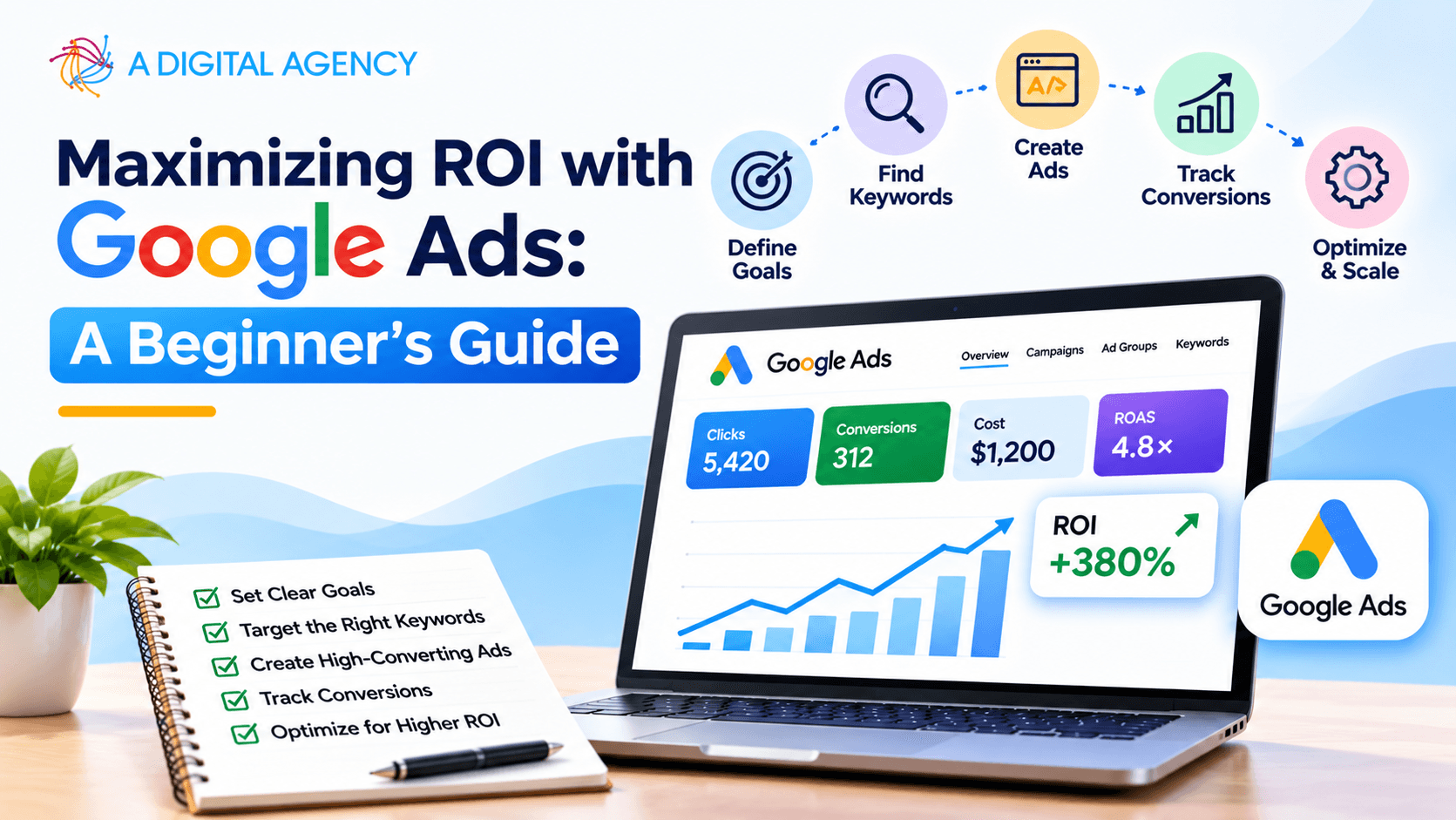
Maximizing ROI with Google Ads: A Beginner’s Guide
Learn how to maximize Google Ads ROI in 2026 with smarter bidding, keyword targeting, conversion tracking, and proven PPC optimization strategies.
Google Ads remains one of the most powerful digital advertising platforms for businesses looking to attract customers, generate leads, and increase sales. However, simply launching an advertising campaign does not guarantee profitable results.
In 2026, businesses face increasing competition, evolving customer behavior, and more sophisticated AI-powered advertising tools. Understanding how to manage campaigns efficiently has become essential for controlling advertising costs and improving return on investment.
For beginners, Google Ads may initially seem complicated. Campaign settings, keyword targeting, bidding strategies, conversion tracking, and performance reports all influence advertising success.
The good news is that businesses do not need enormous budgets to get started. A structured approach, clear objectives, and continuous optimization can help advertisers make better decisions.
This guide explains how Google Ads works, how to measure advertising performance, and which strategies can help beginners maximize their advertising ROI in 2026.
What Is Google Ads and How Does It Work?
Google Ads is an online advertising platform that enables businesses to promote products and services across Google Search, YouTube, Google Maps, and other eligible advertising placements.
Advertisers create campaigns based on specific marketing objectives, such as generating website visits, receiving customer inquiries, increasing purchases, or building brand awareness.
For Search campaigns, advertisers can target keywords associated with customer searches.
When someone searches for a relevant product or service, Google evaluates eligible advertisements through an auction process.
Factors including bids, advertisement quality, expected performance, and contextual relevance influence which advertisements appear.
Many Search campaigns use a pay-per-click model, meaning advertisers generally pay when someone clicks their advertisement.
However, Google Ads also supports other campaign formats and payment models.
The objective is to connect relevant advertisements with users who may be interested in a business's offerings.
Understanding ROI and ROAS in Google Ads
Before optimizing campaigns, businesses must understand two important advertising measurements: return on investment and return on ad spend.
Although these terms are related, they measure different aspects of profitability.
What Is Return on Investment?
ROI evaluates the financial return generated after considering relevant business costs.
A simplified formula is:
ROI = (Net Profit ÷ Total Investment) × 100
For example, suppose a company generates $5,000 in revenue from an advertising campaign.
If advertising costs $1,000 and additional product, fulfillment, and operating costs total $2,000, the resulting profit is $2,000.
The ROI, based on total costs of $3,000, is approximately 66.7%.
This calculation demonstrates why revenue alone cannot determine campaign profitability.
What Is Return on Ad Spend?
ROAS measures the revenue generated relative to advertising expenditure.
ROAS = Advertising Revenue ÷ Advertising Spend
If a business spends $1,000 on advertisements and generates $5,000 in attributed revenue, its ROAS is 5:1, or 500%.
However, a high ROAS does not automatically guarantee profitability.
Businesses must consider product margins, operational expenses, refunds, and other relevant costs.
Both ROI and ROAS provide useful information when evaluating Google Ads performance.
Step 1: Define Clear Advertising Goals
Successful campaigns begin with measurable business objectives.
Before spending money, businesses should identify what they want advertisements to accomplish.
Possible objectives include increasing online purchases, generating qualified leads, booking consultations, or encouraging phone inquiries.
Each objective requires a different approach to campaign setup and performance measurement.
For example, an ecommerce store may prioritize purchase revenue, while a professional services company may focus on qualified consultation requests.
Businesses should avoid selecting advertising goals based exclusively on website traffic.
Traffic matters only when visitors contribute to meaningful business outcomes.
Establishing clear objectives helps advertisers choose appropriate campaigns, bidding strategies, and conversion measurements.
Step 2: Research High-Intent Keywords
Keyword research is fundamental to successful Google Search advertising.
Keywords help advertisers reach people searching for relevant information, products, or services.
However, not every keyword represents the same purchasing intention.
Broad informational searches may generate interest without producing immediate sales.
Commercial and transactional searches often indicate stronger purchasing intent.
For example, a company selling accounting software might compare searches such as "what is accounting software" with "buy accounting software for small business."
The second search generally suggests greater readiness to purchase.
Use Google Keyword Planner
Google Keyword Planner helps advertisers research keyword ideas, estimated search demand, and potential advertising costs.
Beginners should focus on keywords closely related to their products and services.
Long-tail keywords can also be valuable because they express more specific customer needs.
Rather than choosing keywords entirely according to search volume, businesses should consider relevance, competition, and expected conversion value.
Step 3: Understand Keyword Match Types
Google Ads provides keyword match types that influence which searches may trigger advertisements.
The primary options include broad match, phrase match, and exact match.
Broad match offers wider coverage and can identify additional relevant searches.
Phrase match provides more controlled matching based on the meaning of the keyword.
Exact match focuses on searches sharing the same meaning or intent as the selected keyword.
Importantly, exact match does not mean advertisements appear only when users type an identical sequence of words.
Beginners should understand how match types affect search relevance before expanding their campaigns.
Selecting appropriate match types helps balance audience reach with advertising control.
Step 4: Use Negative Keywords to Reduce Wasted Spending
Negative keywords prevent advertisements from appearing for selected irrelevant searches.
For example, a company selling premium business software may want to exclude certain searches specifically seeking free alternatives.
This prevents some advertising expenditure from going toward users unlikely to purchase the offered product.
Businesses should regularly review available search term reports to identify irrelevant queries.
Negative keywords must be selected carefully because excessive exclusions can prevent advertisements from reaching suitable customers.
Effective negative keyword management improves targeting efficiency and supports better budget utilization.
Step 5: Choose the Right Google Ads Campaign Type
Google Ads offers several campaign options designed for different advertising objectives.
Search Campaigns
Search campaigns display text advertisements in response to relevant searches.
They can be particularly useful for reaching users actively researching products or services.
Display Campaigns
Display campaigns show visual advertisements across eligible websites, applications, and placements.
They can support awareness and audience engagement.
Shopping Campaigns
Shopping advertising helps eligible retailers showcase products with information such as images and prices.
These campaigns can support ecommerce sales when product feeds are configured accurately.
Video Campaigns
Video advertising allows brands to communicate through engaging visual content, including eligible YouTube placements.
Performance Max Campaigns
Performance Max uses Google's AI to optimize campaigns across multiple Google advertising channels according to selected conversion goals.
It can help businesses expand reach, but success depends on accurate tracking, suitable creative assets, and clear objectives.
Beginners should select campaign types according to their goals rather than assuming one format is universally superior.
Step 6: Create Compelling Advertisements
Effective Google Ads copy connects the customer's search with a relevant product or service.
Advertisements should communicate what the business offers and why the user should consider it.
Strong advertising messages usually include a clear value proposition, relevant benefits, and a direct call to action.
For example, a local accounting firm might highlight small business tax preparation services and encourage users to schedule a consultation.
Avoid exaggerated promises or promotional claims that cannot be supported.
Improve Responsive Search Ads
Responsive Search Ads allow advertisers to provide multiple headline and description options.
Google can test different combinations to identify messages predicted to perform well.
Advertisers should include distinct, relevant headlines rather than repeating the same statement.
Accurate messaging improves customer expectations and helps create consistency between advertisements and landing pages.
Step 7: Optimize Landing Pages for Conversions
A successful advertisement encourages a click, but the landing page determines what happens afterward.
Sending traffic to poorly designed pages can waste advertising expenditure.
Landing pages should reflect the advertisement's message and provide a clear path toward the intended action.
Important Landing Page Elements
Relevant headlines: Explain the product or service immediately.
Clear calls to action: Make it easy to request information, book an appointment, or purchase.
Fast loading performance: Reduce unnecessary delays that may frustrate visitors.
Mobile responsiveness: Ensure forms, navigation, and content work effectively on smaller screens.
Trust signals: Include accurate customer reviews, relevant credentials, and genuine testimonials.
Simple forms: Request only the information necessary for the next step.
Landing page optimization can improve conversion rates without requiring a proportional increase in advertising spend.
Step 8: Select an Appropriate Bidding Strategy
Google Ads provides automated bidding options that support different business objectives.
In 2026, Google's Smart Bidding technology uses machine learning to evaluate signals and adjust bids during eligible advertising auctions.
Common strategies include:
Maximize Clicks: Designed to generate website visits within a specified budget.
Maximize Conversions: Focuses on producing as many tracked conversions as possible within budget constraints.
Target CPA: Optimizes toward an average cost per acquisition target.
Maximize Conversion Value: Focuses on generating the highest possible reported conversion value within budget constraints.
Target ROAS: Attempts to achieve an average return on ad spend target while maximizing conversion value.
Google updated the labeling of certain target-based bidding strategies during 2026, so interface terminology may differ from older tutorials.
Beginners should choose strategies according to their conversion tracking quality, campaign objectives, and available performance data.
Automated bidding can be useful, but it cannot compensate for inaccurate conversion measurements.
Step 9: Set a Realistic Advertising Budget
Google Ads allows advertisers to establish average daily campaign budgets.
However, setting an appropriate budget requires understanding likely advertising costs and customer value.
Businesses should consider expected cost per click, conversion rates, average transaction value, and profit margins.
For example, a company selling high-value professional services may tolerate a higher customer acquisition cost than a retailer selling inexpensive products.
Beginners should establish a manageable testing budget rather than immediately committing substantial expenditure.
Initial campaign data can help identify which keywords, advertisements, and audiences produce valuable results.
Budget allocation should gradually reflect actual campaign performance.
Avoid increasing spending simply because a campaign generates a large number of clicks.
Step 10: Implement Accurate Conversion Tracking
Conversion tracking is essential for evaluating advertising effectiveness.
Without reliable tracking, businesses cannot confidently determine which campaigns generate useful outcomes.
Google Ads can measure actions such as purchases, form submissions, phone inquiries, and other defined conversions.
Google Analytics 4 can provide additional insights into website behavior and user interactions.
Businesses should verify that important conversion actions are recorded correctly.
Duplicate conversions, improperly configured events, and inaccurate revenue values can distort performance reports.
For lead generation campaigns, connecting advertising information with CRM outcomes can help distinguish qualified leads from low-value inquiries.
Better measurement allows businesses to optimize toward real customer outcomes rather than superficial engagement metrics.
Step 11: Improve Campaign Performance Through Testing
Google Ads optimization is an ongoing process.
Advertisers should regularly review campaign results to identify opportunities for improvement.
Testing can include different headlines, calls to action, keyword groups, landing page layouts, and audience settings.
However, changing too many variables simultaneously makes results difficult to interpret.
Businesses should use structured experiments and allow sufficient data to accumulate before drawing conclusions.
Performance changes should be evaluated according to relevant business outcomes.
A campaign with fewer clicks may still perform better if those clicks generate more profitable customers.
Continuous testing helps advertisers make decisions based on evidence rather than assumptions.
Step 12: Monitor Important Google Ads Metrics
Several advertising metrics help businesses evaluate campaign effectiveness.
Click-Through Rate (CTR): Measures the percentage of impressions resulting in clicks.
Cost Per Click (CPC): Indicates the average amount paid for advertising clicks.
Conversion Rate: Measures the proportion of interactions resulting in desired actions.
Cost Per Acquisition (CPA): Shows the advertising cost associated with acquiring a conversion.
Return on Ad Spend (ROAS): Compares attributed revenue with advertising expenditure.
Conversion Value: Represents the business value assigned to tracked conversions.
Customer Acquisition Cost (CAC): Considers the broader cost of gaining customers when the required information is available.
These metrics should be interpreted together.
A low CPC may look attractive but provide little value if visitors rarely convert.
Similarly, high conversion volume may be unprofitable when customer acquisition costs exceed realistic margins.
Common Google Ads Mistakes Beginners Should Avoid
New advertisers sometimes focus excessively on traffic while overlooking conversion quality.
Common mistakes include targeting irrelevant keywords, ignoring negative keywords, and sending visitors to generic homepage experiences.
Other problems include weak advertisement messaging, unrealistic bidding targets, and insufficient conversion tracking.
Businesses may also make campaign changes too frequently, preventing reliable performance evaluation.
Another mistake is expecting immediate profitability without allowing reasonable time for testing and optimization.
Google Ads provides valuable data, but successful advertising still requires strategic decisions and consistent attention.
The Role of AI in Google Ads in 2026
Artificial intelligence plays an increasingly important role in Google's advertising ecosystem.
Automated bidding, responsive advertisements, and Performance Max campaigns use machine learning to support campaign delivery and optimization.
These technologies can help businesses respond to changing search behavior and customer signals.
However, advertisers should maintain control over campaign objectives, conversion definitions, budgets, and brand messaging.
AI-generated creative assets should be reviewed for accuracy and appropriateness.
Businesses must also monitor whether automated systems are attracting relevant audiences and generating valuable outcomes.
The strongest approach combines automation with human oversight, reliable measurement, and clear business strategy.
How to Maximize Google Ads ROI Over Time
Long-term advertising success requires regular evaluation of profitability.
Businesses should prioritize campaigns that produce qualified customers rather than simply generating inexpensive traffic.
Landing page improvements, better keyword selection, and stronger conversion tracking can increase efficiency.
It is also important to understand customer lifetime value.
A campaign may appear expensive when measured against the first purchase but become more attractive if customers make profitable repeat purchases.
However, businesses should avoid assuming future customer value without supporting historical data.
Consistent reporting helps identify where advertising budgets produce the strongest commercial results.
As campaigns mature, advertisers can gradually refine bidding targets, expand successful keyword groups, and test new opportunities.
Conclusion
Maximizing ROI with Google Ads in 2026 requires a combination of strategic planning, accurate tracking, relevant targeting, and continuous optimization.
For beginners, the most important step is understanding that successful advertising depends on business outcomes rather than clicks alone.
Keyword research, effective ad copy, optimized landing pages, appropriate bidding strategies, and reliable conversion measurement all contribute to better performance.
AI-powered tools can improve efficiency, but they work best when supported by clear objectives and accurate information.
Businesses that consistently review performance and invest in profitable opportunities can build more sustainable advertising programs.
Ultimately, Google Ads success is not about spending the largest budget. It is about making informed decisions that turn advertising expenditure into measurable business growth.
More in Social Media Marketing
 Social Media Marketing
June 28, 2026
How to Increase Your Business Reach with Social Media Marketing
Expand your business reach with social media marketing using proven strategies to grow your audience, boost engagement, and drive more conversions.
 Social Media Marketing
June 28, 2026
The Top 10 Reasons Your Business Should Be In Social Media
Discover the top 10 reasons your business should use social media to increase brand awareness, engage customers, generate leads, and drive growth.
 Social Media Marketing
June 28, 2026
Instagram Fundamental Changes You Need to Know in 2022
Discover the key Instagram changes you need to know, including algorithm updates, new features, and strategies to boost reach and engagement.