

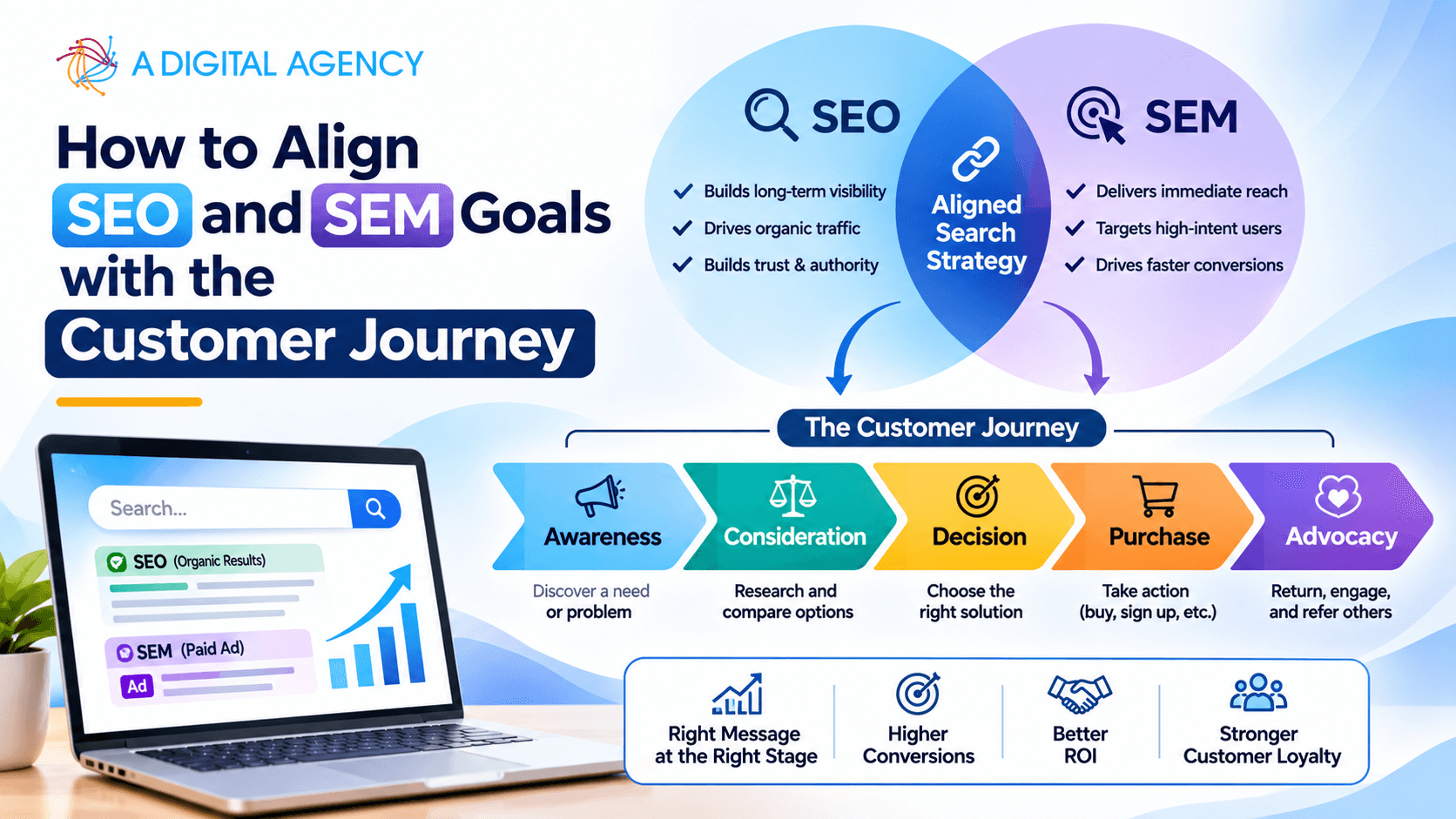
How to Align SEO and SEM Goals with the Customer Journey
Learn how to align SEO and SEM with the customer journey to improve visibility, drive qualified traffic, and increase conversions.
Search marketing works best when it reflects how people actually make decisions. Most customers do not discover a brand, click once, and convert immediately. Instead, they move through a journey that includes awareness, research, comparison, decision-making, purchase, and often post-purchase engagement. That is why businesses need more than isolated SEO campaigns or standalone paid ads. They need a coordinated search strategy.
Aligning SEO and SEM goals with the customer journey helps brands reach people with the right message at the right time. It improves visibility in search results, creates a smoother user experience, and supports stronger conversion performance across the funnel. It also reduces wasted effort. Instead of producing content or launching campaigns without context, marketers can connect every keyword, page, and ad to a clear business objective.
This article explains how to align SEO and SEM with each stage of the customer journey, why this matters for long-term growth, and how businesses can build a more effective search strategy by treating organic and paid search as complementary channels.
Why SEO and SEM Should Work Together
SEO and SEM are often discussed as separate disciplines, but they are most effective when they support the same customer path.
SEO focuses on earning visibility through organic search results. It builds long-term traffic, authority, and trust by helping users discover useful content and relevant pages. SEM, on the other hand, uses paid search advertising to place a brand directly in front of people searching for specific terms. It offers speed, control, and precise targeting.
When these two channels work in alignment, they strengthen each other. SEO can build awareness and capture research-driven searches, while SEM can accelerate visibility for high-intent terms and competitive opportunities. Together, they can support the full customer journey rather than competing for attention within the same marketing plan.
The goal is not simply to rank organically and run ads at the same time. The goal is to understand how users search at each stage of their journey and use SEO and SEM strategically to guide them toward action.
Understanding the Customer Journey in Search Marketing
To align search efforts effectively, businesses need a clear view of the customer journey. While customer behavior varies by industry, most journeys can be organized into five main stages.
1. Awareness
At this stage, the user realizes they have a problem, need, or opportunity. They may not yet know what solution they need or which brands exist. Their searches are broad and informational.
Examples include:
- how to improve team productivity
- why website traffic dropped
- best ways to generate leads online
These searches indicate curiosity rather than immediate purchase intent.
2. Consideration
Now the customer has defined the problem and is actively exploring possible solutions. Search behavior becomes more specific, and the user starts evaluating options.
Examples include:
- best CRM for small business
- SEO vs PPC for lead generation
- top project management software for agencies
The user is comparing approaches, features, or categories.
3. Decision
At this stage, the customer is close to taking action. They may be comparing vendors, reviewing pricing, or looking for final proof.
Examples include:
- HubSpot pricing
- best digital marketing agency near me
- Ahrefs vs Semrush
These searches show high commercial intent.
4. Purchase or Conversion
This is the moment of action. The user signs up, makes a purchase, books a consultation, or completes another valuable conversion.
5. Retention and Advocacy
The journey does not end after the sale. Satisfied customers often return, upgrade, leave reviews, and refer others. Search behavior here may include support-related queries, branded searches, and educational searches that deepen the relationship.
Understanding these stages helps businesses match search intent with the right type of content and paid campaign strategy.
Aligning SEO Goals with the Customer Journey
SEO supports every stage of the customer journey, but its role changes depending on the user’s intent.
SEO for Awareness
At the awareness stage, SEO should focus on educational and discovery-based content. The goal is to appear when people search for answers, definitions, trends, and early-stage solutions.
This often includes:
- blog articles
- beginner guides
- FAQs
- glossary pages
- industry explainers
Success at this stage is usually measured through impressions, traffic growth, brand visibility, and engagement rather than immediate conversions. A business that creates useful, relevant awareness content can build trust early and introduce users to its expertise before competitors enter the picture.
SEO for Consideration
In the consideration stage, SEO content should go deeper. Users want comparisons, frameworks, product categories, case studies, and evaluation guidance.
Strong content formats here include:
- comparison articles
- list-based guides
- feature breakdowns
- use-case pages
- downloadable resources
The objective is to move users from general understanding toward solution preference. Organic content at this stage should answer practical questions, address objections, and help prospects evaluate what fits their needs best.
SEO for Decision
In the decision stage, SEO needs to support conversion-ready searches. This is where service pages, product pages, testimonials, demo pages, and pricing content become critical.
SEO goals here include:
- ranking for branded and high-intent keywords
- improving page quality and conversion relevance
- strengthening trust signals through reviews, proof, and clear messaging
Users in this stage are close to acting, so content must reduce friction. Organic rankings matter, but clarity, usability, and persuasive value matter just as much.
SEO for Retention
Post-purchase SEO often gets overlooked. Yet customers continue to search for onboarding help, product tutorials, support documentation, and advanced usage advice.
Helpful content here may include:
- knowledge base articles
- onboarding guides
- troubleshooting pages
- advanced tips
- customer success resources
This content improves satisfaction and helps strengthen long-term brand relationships.
Aligning SEM Goals with the Customer Journey
SEM brings speed and precision to search marketing. Because paid campaigns can be targeted by keyword intent, location, device, and more, they are especially powerful when mapped carefully to customer journey stages.
SEM for Awareness
Many marketers think paid search is only for bottom-funnel conversions, but it can also support awareness when used strategically. Broad or informational campaigns can introduce a brand to relevant audiences who are beginning their research.
Examples include campaigns targeting:
- educational problem-based keywords
- category-level terms
- new market segments
The messaging at this stage should not be overly aggressive. Instead, it should focus on relevance and value, offering helpful content or a useful next step.
SEM for Consideration
This is often where SEM becomes especially valuable. Users are actively researching and comparing solutions, which makes them more responsive to targeted ad messaging and strong landing pages.
Campaigns at this stage can promote:
- comparison pages
- webinars
- case studies
- solution pages
- lead magnets
A well-structured paid search strategy can capture users at the exact moment they are evaluating options. It also allows brands to test messaging quickly and learn which offers or angles attract the most qualified traffic.
SEM for Decision
Decision-stage SEM is usually the most conversion-focused. These campaigns often target high-intent terms with stronger calls to action, such as:
- buy now
- request a demo
- book a consultation
- get pricing
- start free trial
Ad copy should be direct, clear, and aligned with landing page content. Trust indicators such as ratings, testimonials, awards, or guarantees can improve performance at this stage.
Because competition is often higher for decision-stage keywords, close attention should be paid to Quality Score, conversion tracking, and landing page experience.
SEM for Retention and Loyalty
Paid search can also support existing customers. Branded campaigns, upsell offers, customer support ads, and remarketing strategies can reinforce relationships and encourage repeat value.
In some cases, remarketing across search and display can help re-engage users who visited important pages but did not convert.
Matching Keywords to Journey Stages
The foundation of alignment is intent-based keyword mapping. Instead of organizing keywords only by topic, businesses should group them according to where the user is in the journey.
A simple way to think about this is:
- Awareness keywords: broad, educational, problem-focused
- Consideration keywords: solution-focused, comparative, category-based
- Decision keywords: transactional, vendor-specific, high-intent
- Retention keywords: branded support, onboarding, product usage
This process helps determine whether a keyword should lead to a blog post, a comparison guide, a service page, or a conversion-oriented landing page. It also improves coordination between SEO and SEM teams by giving both sides a shared framework.
Content and Landing Page Alignment
Even the best keyword strategy will underperform if the destination experience does not match user expectations. That is why content and landing pages must align closely with search intent and journey stage.
For early-stage users, landing pages should educate and guide rather than push too hard for conversion. For mid-funnel users, pages should explain options and build confidence. For bottom-funnel users, pages should make action easy.
Strong alignment includes:
- consistent messaging between ad copy and page copy
- clear headlines that reflect the query
- useful calls to action based on user readiness
- supporting proof such as testimonials, data, or examples
- easy navigation for users who need more information
When SEO pages and SEM landing pages are designed with the customer journey in mind, they create a more seamless and effective experience.
Shared Metrics for SEO and SEM Success
One of the biggest reasons SEO and SEM become disconnected is that they are often measured differently. Organic teams may focus on rankings and traffic, while paid teams focus on clicks and cost per acquisition. These metrics matter, but they do not always reflect the full customer journey.
A stronger approach is to define shared goals by stage.
Awareness Metrics
- impressions
- reach
- organic visibility
- click-through rate
- branded search growth
Consideration Metrics
- time on page
- pages per session
- content downloads
- lead quality
- return visits
Decision Metrics
- conversion rate
- cost per lead
- cost per acquisition
- assisted conversions
- sales-qualified leads
Retention Metrics
- repeat purchases
- customer engagement
- support content usage
- referral activity
- lifetime value
By measuring performance through the lens of the customer journey, businesses can evaluate how SEO and SEM contribute together rather than in isolation.
Practical Steps to Build an Aligned Strategy
Businesses looking to align SEO and SEM more effectively can follow a practical process.
First, map the customer journey clearly. Define the stages users move through and identify the questions, goals, and barriers at each step.
Second, perform keyword research based on intent, not just volume. Understand what users are trying to accomplish with each search.
Third, audit existing content and campaigns. Identify gaps where a stage is under-supported or where traffic is being sent to the wrong type of page.
Fourth, align SEO and SEM messaging. Ad copy, page titles, meta descriptions, and landing page content should reinforce the same positioning and value.
Fifth, establish shared reporting. When both channels use a common measurement framework, strategic decisions become more connected.
Finally, test and refine continuously. Search behavior changes, customer expectations evolve, and competitors adapt. Alignment is not a one-time project. It is an ongoing optimization process.
Conclusion
Aligning SEO and SEM goals with the customer journey creates a more intelligent and effective search strategy. Instead of treating paid and organic search as separate channels, businesses can use both to support how real customers discover, evaluate, and choose solutions.
SEO helps build authority, visibility, and trust across the journey, while SEM provides control, speed, and targeted reach at key moments of intent. When both are aligned around customer needs, search intent, and stage-specific goals, they become far more powerful.
The result is not just more traffic. It is more relevant traffic, better user experiences, stronger conversions, and a more sustainable path to growth.
More in SEO Conversations
 SEO Conversations
June 28, 2026
Increase Your Business Customer Base with Local SEO Strategies 2024
Grow your customer base with local SEO strategies in 2024 to improve visibility, attract nearby customers, and boost business growth online.
 SEO Conversations
June 28, 2026
Importance of Google Search Console
Discover the importance of Google Search Console for monitoring website performance, fixing SEO issues, improving rankings, and increasing organic traffic.
 SEO Conversations
June 28, 2026
SEO Automation (2022): What You Need to Know Now
Learn how SEO automation streamlines keyword research, technical audits, content optimization, and reporting to improve rankings and save time.